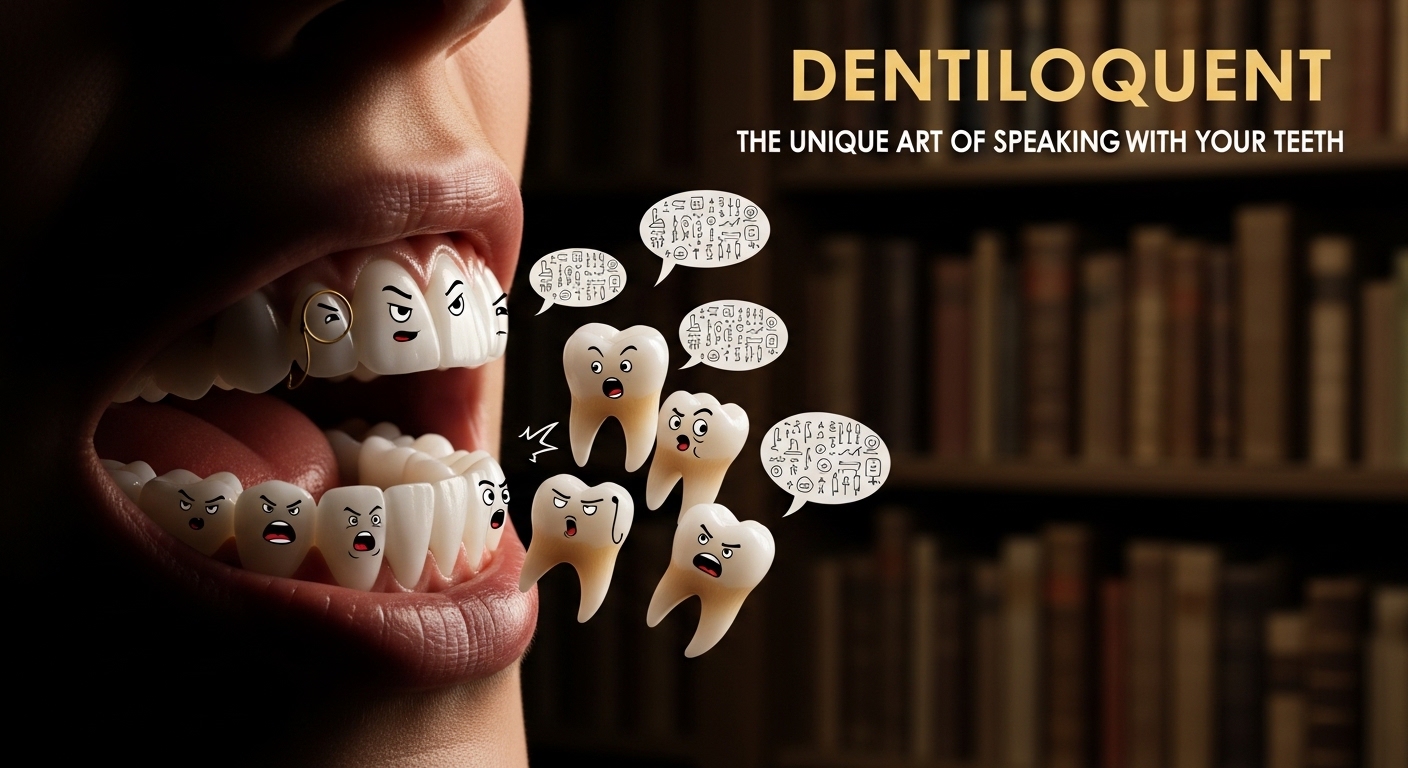
Let's explore the meaning of dentiloquent, its origin, real-life examples, psychological significance, and why this rare word still matters today.
Have you ever watched someone speak while their jaw was locked tight, words squeezing out like they were being held prisoner? Maybe it was a teacher trying not to lose their cool. Perhaps it was a character in a film delivering a line so icy that it chilled the entire room. You felt it, didn't you? That tightness. That controlled, loaded silence wrapped in words.
Let's keep it simple. "Dentiloquent" means speaking through the teeth. Dentiloquent speaking is not whisper-quiet, nor is it loud and dramatic. This refers to a speaking style that is tight, clenched, and controlled, with minimal jaw movement and words that seem to struggle to escape.
Imagine a parent in a grocery store telling a child, "Put. That. Down." Now. "Every word sharp. Every word clipped. That is the kind of speech in real life. It is not just a style of talking. It carries emotion with it.
• Holding back anger or frustration
• Trying to stay composed under pressure
• Speaking discreetly so others don't hear
• Showing quiet authority or cold confidence
The word has roots that go all the way back to Latin. And once you break it down, it makes perfect sense.
"Dens" or "Dentist" is the Latin word for tooth. You see this root in everyday words like "dental," "dentist," and "denture."
"Loqui" is a Latin verb meaning "to speak." This same root shows up in "eloquent," "soliloquy," and "loquacious."
Put them together, and you get dentiloquent, which literally means "speaking with the teeth." The word is precise, visual, and almost poetic. That's the beauty of Latin-based English vocabulary.
• "Dentiloquy" refers to the actual act of speaking through the teeth
• “Dentiloquist” is a person who speaks in this manner
• "Dentiloquent" is the adjective describing this style of speech
You don't need to be a linguist to recognize dentiloquent speech. You've seen it. You've probably even done it without realizing there was a word for it.
• A boss calmly telling an employee, "I won't repeat this again," through a locked jaw
• A person in a tense argument, keeping their voice low but making every word hit hard
• Someone whispering sharply at a wedding to stop an embarrassing situation
• A character in a thriller delivering a cold threat without even raising their voice
What makes this speech so powerful is exactly what makes it different from shouting. It is controlled. It is deliberate. And often, it hits harder than a raised voice ever could.
When people are emotionally tense, their jaw muscles naturally tighten. Dentists and psychologists both recognize jaw clenching as a sign of stress or suppressed emotion. Therefore, when someone speaks eloquently, their body is conveying the truth, even if their words are attempting to remain composed.
This is why eloquent speech carries so much weight. It is body language wrapped in spoken words. The listener might not know the term, but they absolutely feel the message.
Writers love specific language. If you've ever experienced tension in a character's dialogue, it's likely due to dentaloquence.
• They are holding something back
• They are dangerous in a quiet, controlled way
• They have reached a breaking point but are choosing not to explode
Instead of writing "he shouted angrily," a skilled writer might show eloquent speech and let the reader feel the far more chilling effect of quiet, controlled rage.
These two words sound alike and share the same Latin root. But they describe very different things.
Eloquent speech is open, flowing, and expressive. Think of a motivational speaker or a passionate poet who stirs emotions out loud.
Dentiloquent speech is the opposite. It is compressed, guarded, and tense. It holds emotion in rather than releasing it. A skilled speaker might even use such moments deliberately to create contrast and intensity in an otherwise flowing delivery.
Words like dentiloquent remind us that language is full of precision. There is a word for nearly every specific human behavior if you look hard enough.
• Improve your descriptive writing skills
• Help you notice emotional cues in real conversations
• Deepen your understanding of how speech and emotion connect
• Make you more aware of your own speaking habits
Language is not just about talking. It is about noticing. And this speech type teaches you to notice one of the quietest and most powerful forms of human expression.
There is something undeniably human about the way we hold back. The way we bite down on words that feel too big. The way our jaws tighten when we are trying our utmost to stay composed. Dentiloquent speech is the language of that restraint.
This is the calm before the chaos. The controlled whisper that is louder than a shout. Language is full of hidden treasures like this one. Words that wrap entire feelings, behaviors, and moments into a single perfect term. Dentiloquent is one of them.
Now that you know this word, you will never hear a tense, jaw-locked conversation the same way again. Start noticing it. Start using it. And share this article with someone who loves words as much as you do.