Compare manual, semi-automatic and fully automatic pallet wrappers. A practical guide for South African food and beverage packaging operations.
A damaged pallet arriving at a distribution centre rarely comes down to a single major failure. More often than not, it starts with inconsistent wrapping tension, unstable loads, or rushed manual wrapping at the end of a busy shift. For South African food and beverage manufacturers operating high-throughput lines, pallet wrappers have become less of a convenience and more of a critical end-of-line packaging requirement. The right machine improves load stability, reduces film waste, protects products in transit, and helps operations maintain throughput without adding unnecessary labour pressure.
A pallet wrapper, also known as a stretch wrapper or pallet wrapping machine, applies stretch film around palletised loads to secure products during storage and transport. The machine controls film tension and wrap consistency far more accurately than manual wrapping, thereby improving containment force and reducing the risk of load shifting during distribution.
In FMCG environments, pallet wrappers also help reduce stretch film usage by applying controlled pre-stretch ratios. That translates into lower film consumption per pallet and fewer damaged loads arriving at retailers or distribution centres. Whether used on a standalone line or integrated into a larger end-of-line packaging system, the machine plays a direct role in operational efficiency and product protection.
Not every operation requires the same level of automation. The correct machine depends largely on throughput requirements, pallet profile consistency, labour availability, and floor layout.
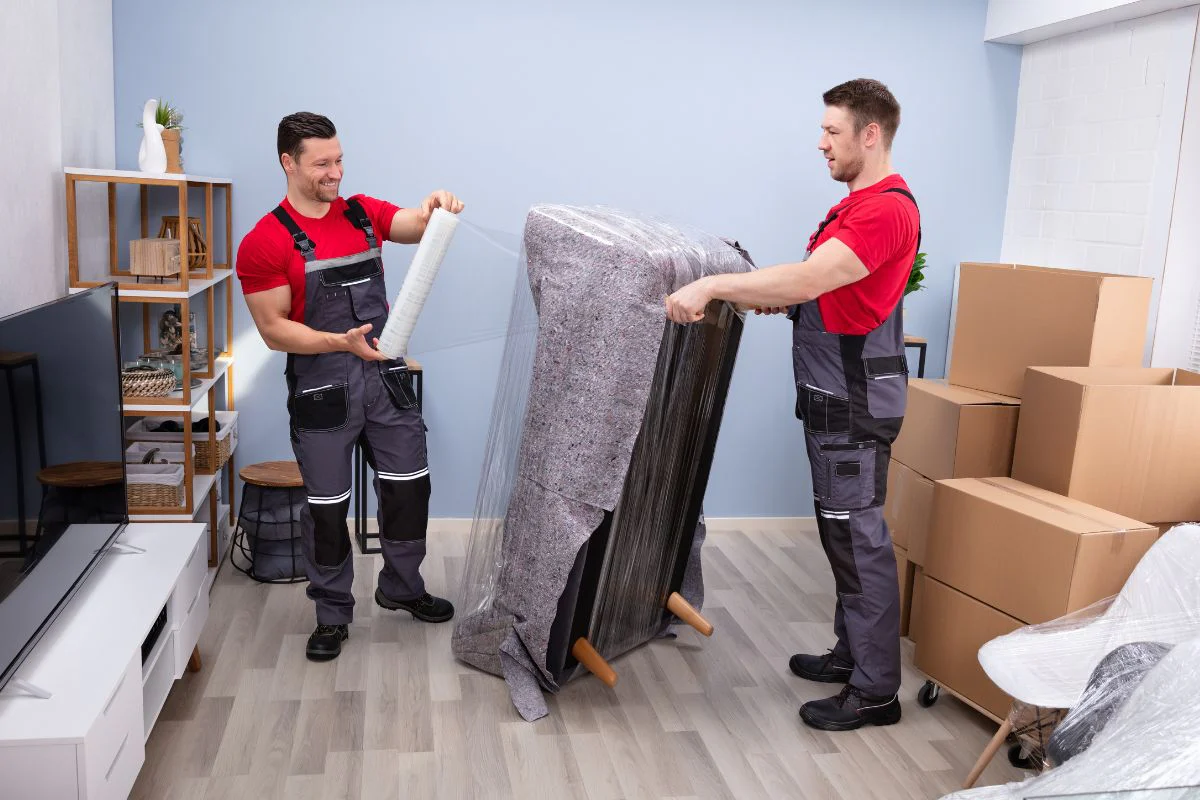
Manual hand wrapping still appears in low-volume warehouses and in flexible production environments that handle fewer than 10 pallets per hour. The advantage is low upfront cost and minimal equipment investment.
The trade-off is consistency. Manual wrapping often results in uneven containment force, inconsistent film tension, and increased stretch film usage. Labour fatigue also becomes a factor during long production runs or peak seasonal demand.
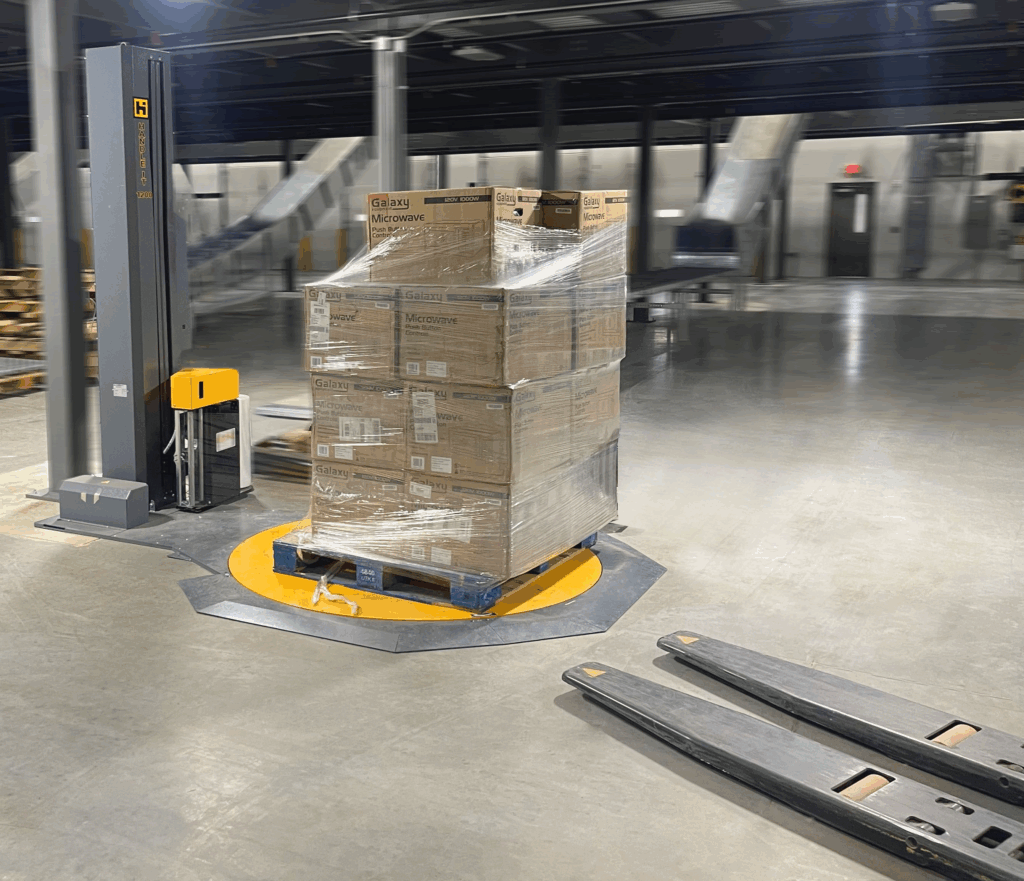
A semi-automatic pallet wrapper, typically using a turntable wrapper design, suits operations processing roughly 10 to 30 pallets per hour. The operator attaches the film to the pallet, starts the wrap cycle, and removes or cuts the film once the cycle is complete.
For many South African FMCG operations, this machine offers a practical balance between cost and efficiency. Machines can run either cast or blown stretch film, depending on load requirements, noise tolerance, and puncture-resistance needs. Cast film generally provides quieter operation and better clarity, while blown film offers stronger puncture resistance for irregular loads.
A fully automatic pallet wrapper removes most manual intervention from the wrapping process. These systems typically integrate directly with conveyor lines and can process 30 to 80 or more pallets per hour, depending on the load profile and wrap cycle settings.
Automatic turntable or rotary arm systems are common in larger food and beverage facilities where throughput consistency matters. Film attachment, wrapping, cutting, and clamping occur automatically, reducing labour dependency and improving repeatability across shifts. Integration with upstream palletisers and downstream logistics systems also improves overall end-of-line packaging flow.
Robotic pallet wrappers move around the pallet instead of rotating the load itself. This makes them suitable for operations with oversized loads, unstable pallet profiles, or facilities where fixed wrapper installation is impractical.
They are commonly used in warehouses with varied floor layouts or multiple wrapping stations. While throughput varies, the flexibility can outweigh the slower cycle speed in certain production environments.
The first question any operation should ask is simple: how many pallets need to be wrapped per hour? Throughput remains the single biggest factor when selecting a pallet wrapping machine. A low-volume facility may achieve acceptable performance from a semi-automatic unit, while higher-output FMCG operations usually require a fully automatic system to prevent bottlenecks.
Load stability matters just as much. Stable pallet profiles containing boxed goods place different demands on a stretch wrapper than irregular or lightweight products. Unstable loads often require more advanced wrap-cycle programming, stronger containment forces, or rotary-arm systems that minimise load movement during wrapping.
Integration requirements also shape the buying decision. Facilities already running conveyor-fed palletising systems should consider whether the pallet wrapper can communicate with existing end-of-line equipment. Poor integration often creates unnecessary stoppages and manual handling points.
Floor space remains another practical consideration. Turntable systems require clear operational zones, whereas robotic wrappers offer greater flexibility in constrained layouts.
Local operations should also evaluate power reliability. Facilities affected by load-shedding or generator operation may prioritise machines with lower power draw, simplified restart procedures, or compatibility with backup power infrastructure.
Finally, purchase price alone rarely tells the full story. A machine with a higher pre-stretch ratio, lower film waste, and reduced labour dependence often delivers a lower total cost of ownership over five years than a cheaper, less efficient unit.
For South African manufacturers evaluating fully automatic options, supplier support and local service capability matter almost as much as machine specification. Downtime on a high-throughput food and beverage line can quickly outweigh any upfront savings gained from lower-cost equipment with limited technical support. Goldpack Packaging supplies a range of pallet wrappers designed for conveyor integration, automated film handling, and continuous production environments. When comparing suppliers, operations teams should evaluate spare parts availability, technician response times, operator training support, and long-term maintenance requirements alongside machine performance specifications.
The right pallet wrapper improves more than load containment. It reduces film waste, protects products during transport, supports throughput targets, and frees operators to focus on higher-value production tasks. In South African FMCG environments where labor efficiency, uptime, and distribution reliability all influence profitability, the machine becomes a strategic operational investment rather than a simple packaging accessory.
Facilities that match machine capability to throughput, load profile, and long-term operating conditions typically see the strongest return over time.